Voltage dividers are fundamental electronic components that enable a specific voltage to be derived from a higher source voltage. They are used not only in simple circuits but also in complex applications, such as:
In high-precision measurement technology, voltage dividers are frequently used to measure extremely high voltages by reducing them to a level that can be measured accurately and safely.
You will explore in this blog post the basics of voltage dividers, how they work, various resistor networks, and custom variants to provide you with a comprehensive understanding of this important electronic concept.
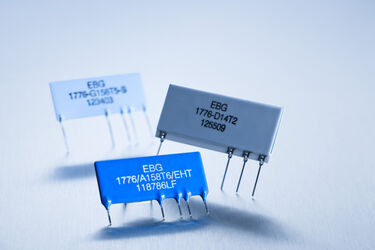
A voltage divider is a simple circuit consisting of two or more resistors that are used to divide a voltage. It utilizes the properties of resistors to produce a reduced output voltage that is proportional to the input voltage.
In its simplest form, a voltage divider consists of two resistors connected in series with three electrical contacts.
This technique is particularly useful when the available voltage is too high for certain components. The voltage divider makes it possible to bring the voltage down to a level suitable for the application.
These components can be found in many electronic devices, from sensors to microcontrollers, and are therefore an indispensable part of modern electronics.
The achievable measurement accuracy depends largely on the precision and stability of the resistor elements used.
The main function of a voltage divider is to convert the input voltage into a lower, desired output voltage. This is particularly important in circuits where different components have different voltage requirements.
Voltage dividers are frequently used to generate reference voltages, adjust measurement signals, or provide voltages for subsequent circuit stages.
Thanks to their simple design and cost-effective implementation, they are a preferred solution in many electronic designs.
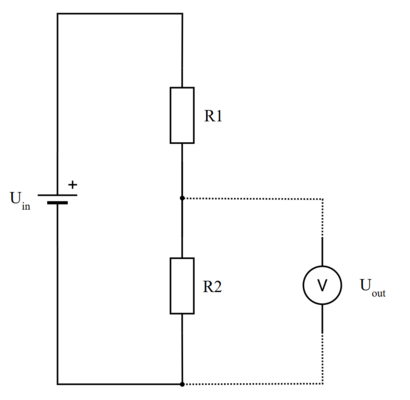
A voltage divider operates according to Ohm's law and the principle of series resistors. When two resistors are connected in series, the total voltage is divided according to the ratio of their resistance values. The formula for calculating this is:
Resistor networks, which consist of multiple resistors, expand the capabilities of voltage dividers. These networks can generate complex voltage and current relationships required in more demanding applications. They are used in signal processing, where multiple signal levels must be adjusted within a circuit.
Example: a well-known example is the R-2R resistor network in digital-to-analog converters (DACs), in which precise resistor values are used to convert digital signals into defined analog voltages.

The requirements for voltage dividers can vary greatly depending on the application, which is why custom solutions are often necessary.
At Miba Resistors, we work closely with customers to develop voltage divider solutions for high-precision measurement technologies. Depending on the application, solutions can be realized using flat resistors or cylindrical resistors with different mounting configurations.

For custom voltage dividers, all relevant parameters must be precisely tailored to the specific application. This is the only way to ensure reliable measurement results and stable voltage conditions over the long term.
The following factors are particularly important:
Voltage dividers are indispensable components in electronics that play a fundamental role in voltage regulation. Their simple operating principle, combined with the flexibility of resistor networks, makes them an ideal solution for numerous applications.
