Smart grids are designed to maintain the stability of power grids, integrate renewable energy sources, and manage bidirectional energy flows from wind farms, solar installations, and electric vehicles. To achieve this, they require precise measurement data.
Voltage sensors collect this data and make it possible to detect grid fluctuations early on, locate faults more quickly, and reliably monitor energy flows.
In this article, you’ll learn how

A smart grid is an intelligent power grid that connects energy generators, storage systems and consumers.
These include:
Since these facilities generate energy at different locations, the power grid must monitor their energy flows. To do this, sensors measure the voltage and energy flow throughout the entire grid.
Smart grids must detect changes in voltage and power flow within the grid. Voltage sensors provide the necessary measurement data for this purpose.
They perform three key functions:
Resistors help voltage sensors measure high voltages in the smart grid in a controlled and precise manner. They step down the voltage to a measurable range.
The resistor is a passive component in the sensor. Its electrical properties affect measurement accuracy and make changes in the power grid detectable.
Several characteristics of the resistor are important for measurement accuracy:
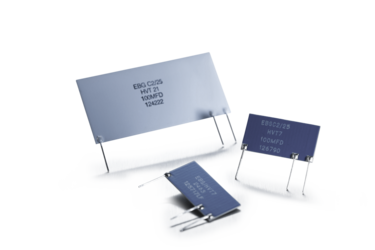
Earlier voltage sensors often used capacitive voltage dividers. With increasing demands on measurement accuracy, many applications today rely on resistive dividers. They enable more precise voltage measurement and help meet the accuracy classes required by modern smart grids.
For high-precision voltage sensors, resistors must maintain their electrical value as constant as possible, even in the face of temperature fluctuations. Even the slightest deviations can affect measurement accuracy. That is why particularly stable, high-precision resistors are used in smart grid applications.

The resistor for a voltage sensor in a smart grid is fabricated in several steps on a circular ceramic substrate. Aluminum oxide ceramic is often used as the material.
The resistor pattern is then applied using screen printing. The paste contains metallic components and glass particles. Among other things, the pattern determines the final resistance value. The thick film is approximately 10 µm thick.
The layout is then sintered at approximately 850 °C. During this process, the material bonds permanently to the carrier substrate.
After sintering, a protective coating is applied to the resistor. This protects the component from external influences. Next, the electrical connections are made.
The entire production cycle can take up to three weeks. The exact duration depends on the quantity and the required process steps.

Resistors for smart grids are tested using the lightning impulse test. The required accuracy class and the behavior under short high-voltage pulses are key factors in this test.
Background: In actual use, resistors must withstand high electrical stresses.
Depending on the size of the voltage sensor, different test voltages are used:
The test values depend on the sensor size and the intended application. This allows us to determine whether the resistor can withstand the electrical stresses.

Episode 3, “Under Voltage,” focuses on Miba Resistors. If you’d like to learn about the technology behind voltage sensors and high-voltage applications from a different perspective, this is the perfect place to start.
Encapsulation is part of the overall implementation of a voltage sensor in the smart grid. Its design is considered in conjunction with the electrical requirements.
A combination is useful when multiple resistor functions need to be integrated into a single package. This allows measurement, power, and high-voltage resistors to be combined into a single package.
At 2,000 watts, the heat generated by the component must be dissipated. This requires active cooling. Therefore, cooling must be taken into account as early as the integration phase of the application.
Validation begins with the requirements of the intended application. Miba reviews these requirements together with the customer and tests the component under defined conditions.
This may include accuracy requirements, sensor size, potting, and lightning strike tests.
